Official Journal of the National Institute for Cancer Research and Treatment (NICRAT)


PEER-REVIEWED • OPEN ACCESS • BI-ANNUAL

Nigerian Journal
of Cancer Research

Nigeria's authoritative scientific platform for cancer research — connecting fundamental biology, clinical practice, epidemiology, public health, policy and innovation across Africa.

3156-2659ISSN
2×Issues per year
CC BY 4.0Open licence
2+Independent reviewers
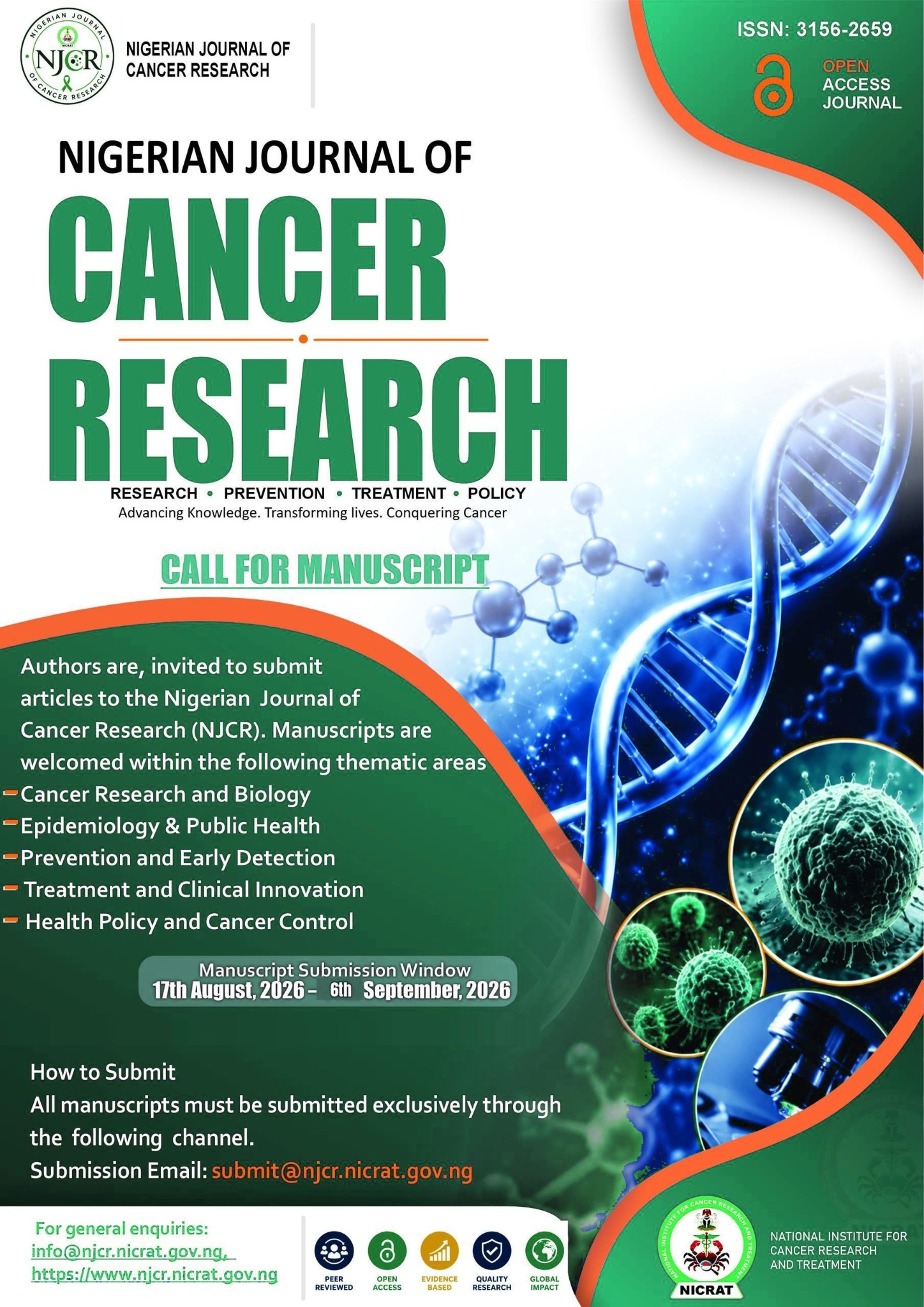
Nigerian Journal of Cancer Research call for manuscript poster
↗
Call for Manuscripts17 Aug — 6 Sep 2026

RESEARCH•PREVENTION•TREATMENT•POLICY
Published by the Directorate of Research and Innovation, NICRAT
THE JOURNAL

A sovereign platform for
African cancer science.

NJCR is the official peer-reviewed, open-access journal of the National Institute for Cancer Research and Treatment (NICRAT), established under the NICRAT Act 2017 and the Federal Government of Nigeria.

M

Mission

To advance scientific understanding, prevention, early detection, treatment and control of cancer through rigorous publication of original research, critical reviews and evidence-based scholarship, with a primary focus on Nigeria and sub-Saharan Africa.

V

Vision

To be the leading, most-cited and most-trusted cancer research journal in Africa — indexing-grade, internationally recognized and irreplaceable to anyone researching cancer in Nigeria.

A

Our ambition

To provide an enduring publication of record spanning the full continuum from fundamental cancer biology to clinical practice, epidemiology, public health and innovation.

SCOPE & PRIORITIES

Research without boundaries.
Impact without borders.

NJCR publishes original work across all domains of cancer science relevant to Nigeria and Africa.

01

Cancer Biology & Basic Sciences

Fundamental mechanisms, molecular oncology and laboratory research.

02

Translational & Clinical Research

Research that connects discoveries with patient care and clinical innovation.

03

Epidemiology & Public Health

Cancer burden, risk factors, outcomes, prevention and population health.

04

Innovation, Technology & Digital Oncology

AI, digital health, diagnostics, data science and emerging technologies.

05

Cancer Prevention & Control

Prevention, early detection, treatment, survivorship and control strategies.

06

Policy & Health Systems / Survivorship & Palliative Care

Policy, health economics, systems research and evidence for resource allocation.

PRIORITY CANCER SITES

Editorial emphasis on cancers of national importance.

BreastCervicalProstateColorectal LiverLymphoma & LeukaemiaPaediatric CancersHead & Neck
LEADERSHIP & GOVERNANCE

Editorial Board.

Meet the editorial team responsible for maintaining the scientific quality, integrity and direction of the Nigerian Journal of Cancer Research.

Editor-in-Chief

Prof. Bala Mohammed Audu

Deputy Editor-in-Chief

Dr. Chinyere Nkiruka Okafor

EDITORIAL LEADERSHIP

Associate Editors

Prof. Bello Arkilla Magaji
Prof. Ige Taofeek
Prof. Mustapha Umar Imam
Prof. Atara Ntekim
Dr. Aliyu Muhammad
Prof. Danladi Adamu Bojude
Prof. Solomon Rotimi
Dr. Aisha Mustapha
Prof. Olugbenga Akindele Silas
Prof. Cyril Chukwudi Dim
Prof. Chioma Asuzu
Prof. Musa Ali-Gombe
Dr. Oiza Tessy Ahmadu
Prof. Omisivie Maduka
Dr. Chidiebere Ogo
Dr. Agbonvihele Gregrey Oko-Oboh
Dr. Shehu Salihu Umar
Dr. Ngozi Idemili-Aronu
Dr. Usman Waziri
Prof. Musa Ali-Gombe
Dr. Joy Iya-Benson
Dr. Arisegi Sarafadeen Adeniyi
Pharm. Margaret Mendie-Sawyerr
Dr. Chinenye Iwuji
Prof. Uche Ijoma
Dr. Amina Yusuf Jega
Dr. Brian Rivers
Dr. Elima Jedy-Agba
Dr. Rakiya Saidu
Editorial Advisors
  • Prof. Emmanuel Ezeome
  • Prof. Echezona Ezeanolue
  • Prof. Olusegun Alatise
  • Prof. Odedina Folakemi
  • Mr. Doyin Bademosi
  • Prof. Ibrahim Malami
  • Prof. Mohammed M. Manga
  • Prof. Taofeek Owonikoko
Editorial Management
  • Senior Managing Editor: Ms. Jennifer Ezinne Ugbala
  • Managing Editor: Mr. Jesse Ekenedirichukwu Nnaji
Editorial Assistants
  • Ms. Bianca Omokuwa Momoh
  • Mr. Musa Sani
  • Mr. Joseph Livinus Sambo
Production Editors
  • Engr. Lukman Abubakar
  • Mr. Stephen Udoka Ojukwu
ARTICLE TYPES

Choose the right
publication format.

Clear article categories and transparent limits help authors prepare submissions efficiently.

Article typeScopeMaximum
Original Research ArticleFull empirical study — basic, clinical or epidemiological5,000 words
Systematic Review / Meta-AnalysisEvidence synthesis following PRISMA7,000 words
Narrative ReviewExpert synthesis of a defined topic6,000 words
Short CommunicationPreliminary significant findings or methodological notes2,500 words
Case Report / Case SeriesNovel or instructive clinical presentations2,000 words
Research ProtocolRegistered trial or study protocol3,500 words
Letter to the EditorScientific commentary or response to published work800 words
EditorialExpert opinion on emerging cancer research issuesBy invitation
Special Issue / SupplementThematic collections on priority cancer topicsOn application
FOR AUTHORS

Ready to contribute to
Nigeria's cancer evidence base?

Submit original, unpublished research through the NJCR online submission system or contact the Editorial Office.

AUTHOR GUIDELINES & POLICIES

Transparent standards.
Rigorous scholarship.

Our editorial framework is designed around research integrity, transparency, ethical conduct and international publishing standards.

Manuscript Submission

Manuscripts must be original, unpublished and not simultaneously under consideration elsewhere. Submissions should be made through the NJCR online submission system or by email to submit@njcr.nicrat.gov.ng.

Only electronic Microsoft Word (.docx) files, double-spaced, in 12-point Times New Roman with 2.5 cm margins are accepted. Authors must submit an Author Declaration Form and cover letter.

Peer Review Policy

Manuscripts undergo initial editorial screening followed by double-blind peer review by at least two independent expert reviewers. NJCR targets a first editorial decision within 6–8 weeks.

Reviewers are normally given four weeks, with one extension of up to two weeks. Decisions may be accept, minor revision, major revision, reject with invitation to resubmit, or reject.

Authorship & CRediT

Authorship must meet all four ICMJE criteria: substantial contribution; drafting or critical revision; final approval; and accountability for the work. Contributors who do not qualify should be acknowledged.

Authors should provide individual contributions using the CRediT taxonomy. Changes after submission require written approval from all co-authors.

Conflict of Interest

Authors, reviewers and editors must declare relevant financial and non-financial interests. Declarations are published verbatim with each article, and editors or reviewers with conflicts must recuse themselves.

Ethical Considerations

Studies involving human or animal subjects must include an Ethical Considerations subsection in Methods, naming the reviewing committee, approval number or waiver, consent process and data-protection measures.

Clinical trials must be prospectively registered in a WHO-approved registry before recruitment. Animal research must comply with Nigerian legislation and recognized guidelines such as ARRIVE 2.0.

Manuscript Preparation

Original research articles should include Abstract, Keywords, Introduction, Materials and Methods, Results, Discussion, Conclusion, References, Figures and Tables.

Abstracts are limited to 300 words and should use Background, Objective, Methods, Results and Conclusion. Keywords should contain 5–8 MeSH-compliant terms.

References & Vancouver Style

References must use Vancouver superscript style exclusively and be numbered in the order first cited. Journal titles should follow NLM Index Medicus abbreviations. For more than six authors, list the first six followed by “et al.”

Tables & Illustrations

Tables should be self-explanatory and must not exceed 10 columns or 25 rows. Figures must be sequentially numbered, legible after reduction, and accompanied by concise legends. Digital images require a minimum of 300 dpi or 1800 × 1600 pixels in TIFF format.

Patient Privacy

Identifying patient details must not be published unless scientifically necessary and informed consent for publication has been obtained. Authors are responsible for obtaining and retaining patient consent documentation.

Data Sharing Policy

NJCR strongly promotes open science. Authors are encouraged to deposit underlying data, code and analysis files in recognized repositories. Where sharing is restricted, the Data Availability Statement must explain the restriction and access pathway.

Corrections, Retractions & Concerns

NJCR distinguishes errata, corrigenda, retractions and expressions of concern. Post-publication notices remain permanently linked to the original article and retracted articles remain in the archive with clear retraction labels.

Appeals & Policy Review

Authors may submit a formal appeal within 30 days of rejection where there are fundamental procedural flaws or serious factual inaccuracies. The Editorial Policy is reviewed annually and archived for transparency.

Copyright & Editorial Independence

Authors retain copyright and grant NICRAT a non-exclusive licence to publish and archive. Articles are published under CC BY 4.0. Despite institutional affiliation with NICRAT and the Federal Government, NJCR maintains complete editorial independence in publication decisions.

PEER
REVIEWED
Double-blind review
OPEN
ACCESS
CC BY 4.0
EVIDENCE
BASED
Rigorous scholarship
QUALITY
RESEARCH
Research integrity
GLOBAL
IMPACT
Africa & beyond
PUBLICATION MODEL

Open by design.
Built for discovery.

NJCR is fully open access and published biannually in English. Articles are published under CC BY 4.0 and assigned a permanent Crossref DOI.

INDEXING TARGETS
AJOLPubMed / MEDLINEScopusWeb of ScienceDOAJCrossref
Indexing applications and progress will be communicated transparently as the journal develops.
EDITORIAL OFFICE

Let's advance
cancer science together.

Department of Research and Innovation
National Institute for Cancer Research and Treatment (NICRAT)